The University
Through
the
Eyes of Faith
A Symposium
on Evangelical
Higher
Education
Probes
the
Relationship
of Faith
and Intellect
By Jennifer Johnson Gilnett
The Growth of World Evangelicalism
Nurturing Evangelical Intellectuals
The Future of Evangelical Higher Education
Left to right: Thomas Oden, Alister McGrath and James I. Packer |
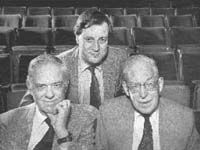
Seattle Pacific and other evangelical universities must be key players in nurturing "the life of the mind" among evangelical Christians, said speakers at the Symposium on Evangelicalism and Higher Education February 10-14. The week-long event brought to SPU guest scholars who have been outspoken in challenging the evangelical community to cultivate the intellect in the service of Christ.
"Who are the people who are going to write the books, who are going to change the way a culture thinks...?" asked Alister McGrath, principal of Wycliffe Hall at the University of Oxford, during a keynote address. "Educators [and] education matter profoundly. They shape our vision of the world."
Individuals from three nations, 14 states and a variety of Christian traditions joined SPU faculty, staff and students at the Symposium, designed as the centerpiece of the University's "Inaugural Year" celebration. A first of its kind in terms of size, breadth and diversity of representation, the event touched on many aspects of evangelicalism and intellectual life.
"Our purpose was to discuss vital issues that affect our work and our future at Seattle Pacific," says Philip Eaton, who was installed as SPU's ninth president in September. "We also wanted to contribute to a larger conversation within Christian higher education."
What Eaton described as the Symposium's "pivot point" was a Wednesday evening panel presentation featuring some of the world's leading evangelical voices: McGrath; Thomas Oden, professor of theology and ethics at Drew University; James I. Packer, professor of theology at Regent College; and Steven Nicholson, senior fellow in higher education at the Murdock Charitable Trust. Representing different Christian traditions, and known for championing both intellectual and spiritual integrity, they helped sharpen the Symposium's central themes.
The Growth of World Evangelicalism
The four Symposium panel members agreed that within world Christianity, the relatively new movement of evangelicalism has become a comparable "partner in dialogue to Roman Catholicism and Eastern Orthodoxy," as described by Oden, who has participated in international meetings of the three bodies. This is due in part, they said, to both its theological perspective and the sheer numbers of evangelical Christians in the world.
"There has never been such a spectacular spread of evangelical faith at any time in world history as...in the second half of the 20th century," said Packer, a senior statesman in evangelicalism who defined the movement as a brand of Christianity that is trinitarian, Bible-believing, Christ-centered, conversionist and with a view of the Church as a transdenominational fellowship. "...We have already moved into a world scene where evangelicals of one sort or another are the statistical majority."
According to the panelists, evangelicalism is best described as a shared understanding of the Gospel, without a fixed denominational identity. Consequently, it is a significant presence across all Christian denominations. The future growth of evangelicalism will likely be within the Roman Catholic and Greek Orthodox churches, and in countries such as China and South America, asserted Nicholson, a former missionary, businessman and university president. "Evangelicalism has yet to discover its full force."

Nurturing Evangelical Intellectuals
A recurrent theme throughout the Symposium was that the growth of evangelical Christianity makes the need for first-rate evangelical scholarship acute. In his keynote address, McGrath pointed out that "evangelicalism has always...been suspicious of the academic world." He cited genuine concerns on the part of evangelicals about higher education's relevance to Christian ministry and its perceived "elitism, ideological warfare and rampant anti-religious propaganda."
But the author of A Passion for Truth: The Intellectual Coherence of Evangelicalism, went on to argue that Christians will only make an impact on the world if they participate in the intellectual life of the culture. They should be confident, he asserted, that a vital piety can be fully integrated with an energetic life of the mind. "Being an evangelical does not mean committing intellectual suicide," he said during the panel presentation. "There is a real rigor and intellectual coherence to evangelicalism which can stand up to the best that the secular world can offer."
For Oden, a renowned Wesleyan theologian whose spiritual and intellectual journey has led him through self-described "faddish" theologies to an embrace of classical Christianity, the demise of modern intellectual assumptions is an opening for Christian thought. "Modernity is in a very defensive, very vulnerable position...," he stated. "If you oriented your life around Marx, Freud, Nietzsche and Rousseau, would you think you had a future after the twentieth century?"
There is a need, agreed Packer, for thoughtful Christians to confront, in an integrated and intellectually viable way, "the relativism, the nihilism and the moral dissolution of values that is so sad a mark of our culture." In this environment, the author of the classic Knowing God continued, the Christian university is particularly well-positioned to influence the way a culture thinks. "I think that Christian universities...are institutions of enormous potential importance for the future," he said.
The Future of Evangelical
Higher Education
What, then, does the future hold for the world's evangelical Christian universities? What are the "key commitments" that must be present in order for them to stay true to their mission and effectively counter the spiritual vacuum of the modern secular academy?
Packer pointed to three essential commitments of an evangelical university: to a Christian faith "which is orthodox, evangelical and trinitarian in quality and which is plugged into the heritage of Christian understanding as it has developed over 2,000 years"; to "academic integrity aiming at academic excellence in all fields of study"; and to an institutional "practice of community spirituality." Without any one of these, he said, the Christian university will be ineffective.
A university functions as it is structured, noted Nicholson, drawing on his background in international business. He called for evangelical Christian institutions of higher learning to seriously evaluate their organizational structures to be certain they reflect the central mission. Similarly, McGrath called for "safeguards" to be built into the institutional structures which would prevent drifting from the mission. "There's a lesson to be learned from history, that an institution can drift over a long period of time unless there is a concerted effort to maintain [its commitments]," he said.
Today's evangelical Christian university must be focused on seizing the opportunities provided by the collapse of the "modern illusion," said Oden. "There is great vitality in the evangelical and classical Christian critique of those [modern] ideas," he argued, later asserting that true academic freedom can be found in the Christian university, where education is viewed from the perspective of the "wholeness of the work of God in history."
The venerable Packer brought the panel discussion to an end by affirming the words of Oden. He noted the prevalent view that the Christian university has a closed mind and the secular university an open mind. "The precise reverse is true at the present and is likely to be true for the foreseeable future...," he stated emphatically. "As I look into the future I am persuaded that the...role of the Christian university is likely to be more significant than it has ever been."

Please read our disclaimer.
Send any questions, comments or correspondence about Response to
jgilnett@spu.edu
|