Cultivating Christian Thought: A Sampling
of Symposium Topics
Stories by Chad Pecknold, Jennifer Johnson Gilnett, Richard Steele and Connie McDougall
Subheadings:
The
American Academy Today
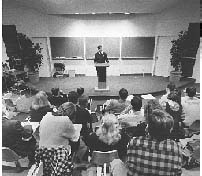
Throughout the week, participants in the Symposium on Evangelicalism and Higher Education wrestled with what it means to think carefully as Christians across the spectrum of higher learning. The following are examples of individual topics and presentations.
William Hull, University Professor,
Samford
University
The American
Academy Today
William Hull, former provost of Samford University, is now "University Professor" at Samford, charged with the task of helping faculty integrate faith and learning. Speaking at the Symposium, the ordained Baptist commended the event as "...a major statement reaffirming [SPU's] historic mission as a Christian university."
In "An Evangelical Retrospective" and other addresses, Hull focused on the historical development of colleges and universities in America, pointing to the fact that most were founded with a clear understanding of the Christian faith as the center of their mission. But as the institutions developed during the twentieth century, he said, many followed the dominant culture and pushed Christianity to the margins.
Today, argued Hull, we find ourselves at "...the end of a cultural epoch during which powerful reactionary forces conspired to produce the virtual collapse of the Christian university concept...." He described this as a demanding time with opportunities that Christian universities dare not miss. After the tumultuous era of the 1960s and 70s, some academics began to talk openly about a collapse of values and a crisis of purpose in America's secular universities. Now, he concluded, we are beginning to see signs that Americans are once again looking for "rootedness" in higher education.
Hull asked Symposium participants to ponder the Christian university's definition of an "educated person." For Hull, "...educated persons know how to define ultimate concerns that will decisively shape both belief and behavior." And he urged SPU to be passionately concerned for this vital integration.
"Evangelical higher education in the past half-century has been a success story," Hull proclaimed. "Enrollments grow, facilities expand, budgets enlarge, influence increases - and the result is a prevailing mood of optimism, of confidence in the future."

Nancy Pearcey, Fellow and Policy Director, The Wilberforce Forum
The Soul of Science
Refuting the view that religion is "anti-science," writer Nancy Pearcey set out to show that "the relationship of religion to science has actually been largely beneficial." In her Symposium address, "The Soul of Science," Pearcey stated that historians of science widely agree that the Christian faith provided many of the "foundational intellectual assumptions" of modern science. She cited several key attitudes toward nature which came from Christianity and helped to legitimatize the study of the physical world, among these the beliefs that nature is not divine and therefore appropriate for study; that nature is good, not evil; and that nature is orderly and lawful.
Early science history offers many examples of great scientists whose Christian faith "guided their scientific work" and who should be models today, Pearcey also said. She developed this theme in her second presentation, "Science and World View."
Pearcey was later joined by three scientists in a panel discussion about the teaching of science at a Christian university. Panelist Cynthia Fitch, assistant professor of biology at Seattle Pacific, began by emphasizing that Christian college graduates "must be literate in science" in order to influence the discussion of pressing ethical questions.
Following Fitch, Pearcey talked about the importance of distinguishing between the "facts of science" and the materialistic philosophy often associated with modern science. Robert Russell, professor of science and theology at the Graduate Theological Union of Berkeley, speculated, among other things, on the possibility of developing a scholarly methodology that relates theology and science.
A molecular biologist at the University of Washington School of Medicine, John Medina emphasized both the God-given curiosity which motivates the Christian scientist, and the "boundaries" of science. "Science can only measure physical things," he said. "...We make science much too large when we ask it to answer questions it is inherently incapable of addressing."
Thomas Oden, Professor of Theology and Ethics, Drew University
The Renewal of Classical Christianity
Thomas Oden participated in the Symposium as the 1997 Alfred S. Palmer Lecturer in Wesleyan Studies. On the face of it, Oden's topic, "The Renewal of Classical Christianity," seemed far afield of "Wesleyan studies." However, John Wesley was a keen student of early Christianity and Oden's thesis was that we too must retrieve the riches of Christian antiquity. Indeed, he insisted, such retrieval is key to spiritual renewal in our times.
In the first of three lectures, Oden described how overwhelmed he was some years ago when he first immersed himself in the writings of the Church fathers. In contrast to many histories of the early church, which dwell on the bitter doctrinal disputes of that period, Oden has discovered a high degree of consensus on most major issues. He points to the work of Vincent of Lerins, a fifth century historian and theologian who showed that, among Christians, there was a doctrinal core of the faith that was believed "always, everywhere and by everyone."
Oden went on in his second presentation to describe his own intellectual captivity to the "narcissism, individualism, reductionism and naturalism" of the modern secular academy, and told of his gradual deliverance from these "idolatries." What changed him, he said, "was a slow, steady awareness of the guidance by the Holy Spirit of the Christian community over the centuries, of the constancy of God's holy love."
The final Palmer lecture was a detailed account by Oden of the vast project that will probably occupy the remainder of his professional career. He is editing a 27-volume series of Bible commentaries with excerpts from the sermons, prayers, liturgies and commentaries of the ancient Church. Oden hopes to provide for contemporary audiences the treasures of that "classical Christianity" which has so inspired and transformed him.
Patricia Ward, Professor of French and Italian, Vanderbilt University
The Lessons of a
Lost History
American evangelical Christianity, which extends to all people a hope of spiritual revival through the personal experience of God, has a rich, if "lost," history, said Symposium speaker Patricia Ward. For seekers, however, one place that tradition can be found is in the work of Jeanne-Marie Guyon, a seventeenth century French mystic whose writings influenced John Wesley. Ward described the contributions of Guyon and others in a presentation titled "The Democratization of Spirituality: Lessons From a Lost History."
Writers and mystics such as Guyon are "an important heritage to claim in the currents of American religious history," explained Ward, because they promoted spirituality which "emphasized a theology of experience...accessible to the common people."
Guyon, an aristocrat associated with the French court of Louis XIV, was jailed for her "Quietist" teachings during a time of religious persecution in France. Later released and living under virtual house arrest, she received visitors "from the mystic and pietist communities of Protestant Europe," Ward said. "Ecumenical in outlook and never emphasizing conversion to Catholicism, she welcomed all."
A prolific writer, Guyon wrote 40 volumes including, Ward noted, a 20-volume commentary on the Bible. Wesley introduced Guyon's writings to America, and while he cautioned that she was "far from infallible," he still affirmed her as a woman "deeply devoted to God."
Ward, whose own religious background can be traced to the nineteenth century holiness movement, encouraged her audience to discover America's many lost Christian traditions. "We would do well to learn one another's histories, to respect them," she concluded, emphasizing that mutual understanding is essential to Christian unity.

Please read our disclaimer.
Send any questions, comments or correspondence about Response to
jgilnett@spu.edu
|