On the Waterfront
Falcon Crew Celebrates New Popularity
and Success
By Connie
McDougall
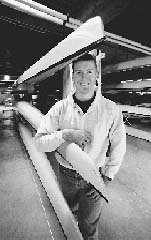
Homecoming at the shellhouse down by the canal finds former warriors of the waves mixing it up with raw recruits. Alums wear T-shirts that read, "The Older We Get, The Better We Were." Novice rowers think, mistakenly, they can beat the older folks in a heartbeat.
Always well-attended, the Seattle Pacific University Homecoming Crew Regatta is a time of racing and fun, but this year's event will be especially upbeat. The program is flourishing after some very lean years. With appearances at national championships in 1995 and 1996, Falcon crew is enjoying its largest roster ever: 63 people. SPU is a contender again.
Most agree that the credit goes to Coach Keith Jefferson's "can-do" spirit. Athletic Director Alan Graham notes that Jefferson's feat is particularly impressive considering the crew budget was cut by 75 percent in 1991. "Through fund-raising diligence, great coaching and committed students, crew has overcome a lot and risen to national acclaim," he says.
The program has always been humble. Begun in 1972 on a shoestring, SPU crew was a club sport only, and even when it achieved varsity status in 1978, there was little financial support available. Jefferson recalls that when he came to Seattle Pacific in 1979 as a freshman, "we got a part-time coach who had a small stipend, and that's when we turned things around."
Jefferson changed too. Uninterested in high school sports ("I was in band!" he laughs), Jefferson found a home in college rowing. "Crew changed my character completely," he says. "I wasn't as tenacious about anything before. From the very start, I loved it."
Following marriage, graduation and a stint in the Marines, Jefferson landed a job as assistant crew coach at SPU, then became head coach when former head coach Jim Schultz retired. Rowers past and present are grateful he took the job.
"Keith pounds the basics into you," says championship rower and 1995 graduate Doug Miller. "He makes sure you have good form."
Crew training has been described as "worse than boot camp," but then Jefferson is in the Marine reserves. Kelly Morris, this year's women's captain, admits she almost dropped out of crew early on because of the grueling schedule: up at 4:00 a.m., on the water by 5:00 and regular runs up Queen Anne hills.
"I didn't know if I could do it, but I'm so glad I did," says Morris. "The rewards of spring racing are worth it." Last year, that meant going to the Pacific Coast Regional Championships. "Oh my gosh," she exclaims, "that race was incredible."
Director Graham believes teaching discipline is Jefferson's strength. "His care for students - spiritually, physically, mentally - requires them to develop to their highest potential."
Very impressive, since the program is open to all, regardless of ability, and there are no cuts. "Keith brings them together as individuals and as a team," says Graham.
According to Mick Zapata, part of the 1994 championship crew and 1996 men's captain, team bonding is real and deep. "Crew has been the most positive experience in my life," he says. "My best friends are here."
The faithful are rewarded with an epiphany of harmony when humans learn to work as one. Pat Berschauer, on the 1995 national championship team and former assistant coach, compares it to a fine ballet. "You get into another world," he says. "The more in sync you are, the less you notice the effort." He adds that Falcon crew is unique, recognizing a spiritual side to rowing. "It's powerful."
Spring racing fast approaches and Jefferson feels encouraged. Yet, major financial challenges remain. "Our aging fleet affects competitiveness," he says, "and the expense of travel is always with us."
Still, at Homecoming, it's a time to celebrate those hard-working crew teams - and a time to thank the crew coach. "Keith has a great sense of humor," says Doug Miller, "and he loves God a lot. Basically, his life is that program and because of him, it's alive."

Please read our disclaimer.
Send any questions, comments or correspondence about Response to jgilnett@spu.edu or call 206-281-2051.
Copyright © 1999 University Communications, Seattle Pacific University.
Seattle Pacific University
Office of University Communications
3307 Third Avenue West
Seattle, Washington 98119-1997
United States of America