|
|
Spring 2007 | Volume 30, Number 1
| Features
|
|
|
Are We Biblically Illiterate? Does It Really Matter?
What would happen if Americans relearned the Bible’s influence on history, art, and culture? What would happen if Christians read their own foundational text closely?

Baffled by the Bible
“What was that all about?”
Broadcasting new songs by the rock band U2 in the spring of 2005, the Seattle radio DJ sounded bewildered.
The song he had just played was called “Yaweh.” With each line, the singer — Bono — pledged allegiance to the Almighty, repeatedly singing out the Hebrew name for God.
The DJ began mocking the chorus. “Yeah, wayyy! Yeah, wayyy!” Then he remarked, “Sometimes, Bono just sings whatever syllables pop into his head.”
A few months later, during a screening of the documentary Super Size Me, moviegoers had a good laugh. Schoolchildren in the film could correctly identify an image of Ronald McDonald, but they did not recognize a drawing of Jesus. “George W. Bush?” one guessed.
More recently, a celebrity youth minister expressed his zeal for Jesus to a mainstream journalist. The antagonistic interviewer asked if he was familiar with the Ten Commandments. The celeb struggled to recall six of them. When asked to name Jesus’ disciples, he was reluctant to try.
These stumbles are symptoms of an epidemic. Significant research confirms that biblically and theologically educated Americans are an endangered species … even within churches. The “technical” term? Biblical illiteracy.
Similar flare-ups of scriptural ignorance are easy to spot — that is, if you know the Bible. During The Tonight Show’s “Man on the Street” interviews, we learn that Eve was created “from an apple,” that Cain’s brother was “the Barbarian,” and that the Christ child was visited by 12 wise men.
Stephen Prothero, in his new book Religious Literacy (HarperSanFrancisco, 2007), points to a November 2000 poll showing that 75 percent of American adults believe — wrongly — that the Bible says, “God helps those who help themselves.” Ten percent think Noah’s wife was Joan of Arc.
Research by The Gallup Organization shows most Americans claim they believe in the Ten Commandments, but few can name them. Only half of the American Christians polled know who preached the Sermon on the Mount. (Hint: It’s not Billy Graham.) Close to 50 percent of American adults read the Bible “seldom” or “never.”
“Although the level of formal education of the U.S. population has climbed dramatically since the 1940s, surveys show that the level of biblical literacy has not kept pace,” says researcher George Gallup Jr. “Americans, both churched and unchurched, remain ‘biblical illiterates.’”
But really … does it matter?
Are Americans at a disadvantage if they don’t know anything about the Bible?
And what are the consequences for Christians who don’t study their own Holy Scriptures?
The Controversy Over Biblical Education
Studies show that Bible reading is not becoming more popular. But interest in biblical ignorance and its consequences is increasing.
Christian Smith, keynote speaker for Seattle Pacific University’s Day of Common Learning in October 2005, is the principal investigator for the National Study of Youth and Religion (NSYR) at The University of Notre Dame. His book Soul Searching gives a sobering look at religious ignorance among American teens.
The NSYR’s 2003 “first-wave” survey examined the Bible-reading habits of 13–17-year-olds. Forty-one percent of those teens never read the Bible, Smith says.
 His findings are consistent with those of The Bible Literacy Project, another prominent effort to research the problem of biblical illiteracy and encourage change. A non-partisan, non-profit organization “dedicated to research and public education on the academic study of the Bible in public and private schools,” the Project has pursued two lines of inquiry. His findings are consistent with those of The Bible Literacy Project, another prominent effort to research the problem of biblical illiteracy and encourage change. A non-partisan, non-profit organization “dedicated to research and public education on the academic study of the Bible in public and private schools,” the Project has pursued two lines of inquiry.
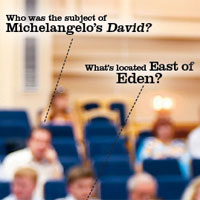
In their first report, the Project analyzed a Gallup survey that polled American public school students between the ages of 13 and 18, asking them what they know about the Bible and other religious literature. Two-thirds of the teens surveyed did not know that Damascus was where the apostle Paul encountered a blinding vision of Jesus. Was David ever king of the Jews? “No,” said 25 percent of them. Eight percent thought that Moses was “one of the 12 apostles.” Christian teenagers scored only a few points better than non-Christians.
For their second report, published in January 2006, the Project asked educators, “Is the Bible an essential part of education?” The overwhelming response, from 39 English professors belonging to 34 of the nation’s leading colleges and universities: “Yes.” George P. Landow of Brown University summarized the prevailing view when he said that an education without study of the Bible is “like using a dictionary with one-third of the words removed.”
The Bible Literacy Project also published a textbook — The Bible and Its Influence (BLP Publishing, 2005). Editors Cullen Schippe and Chuck Stetson guide readers through the various writings compiled in the Bible and examine how it has affected every conceivable area of culture. The textbook, they say, is not designed to proselytize, but rather to give students an objective presentation of the Bible’s content.
In its first year, the textbook is being successfully used in 83 school districts in 30 states. The Bible Literacy Project reports indications for extreme growth in the book’s second year. But, the idea of academic study of the Bible in public schools has vocal opponents, including Americans United for the Separation of Church and State.
The Bible as Foundation (and Fault Line) of American History and Culture
So what are the challenges facing students of American history, art, or literature who do not have lessons about the Bible?
The genesis of American history has everything to do with a dispute over who could speak authoritatively about the Bible. The invention of the printing press in the mid-15th century led to the production of differing Bible translations. Setting the Reformation in motion, Martin Luther was driven by a compulsion to give people access to the Bible, and the chance to read it in their own vernacular. That endeavor became the foundation of education in America, which achieved impressive success in teaching students to read so that they could read the Bible and establish it as the backbone of society.
It was religious persecution that drove the Pilgrims to sail for the New World. Puritan efforts to escape oppression gave rise to the idea of a “promised land,” reflecting the biblical story of the Israelites. The agnostic and skeptic Thomas Paine counted on the Biblical literacy of his audience when, in his pamphlet titled Common Sense, he denounced not only the British monarchy, but the idea of monarchy itself: “[F]or the will of the Almighty, as declared by Gideon and the prophet Samuel, expressly disapproves of government by kings.”
Later, the speeches of Abraham Lincoln, which helped to abolish slavery in America, relied heavily on the Bible. “[It] is the best gift God has given to man,” he said. “But for it we could not know right from wrong. All things most desirable for man’s welfare, here and hereafter, are to be found portrayed in it.” Presidents and public figures have followed his example ever since –– including Martin Luther King Jr., whose “I Have a Dream” speech is fueled by scriptural references.
Beyond history and politics, what are biblically illiterate students to make of classic art? “The Great Codes of Art” — that’s what William Blake, poet and painter, called the Old and New Testaments.
Frederica Matthewes-Green, who has written for The Washington Post, Christianity Today, and The National Review, and published several books on Christian faith, is dismayed to see students lacking exposure to the source of so much artistic inspiration. “Their ability to appreciate the architecture of an ancient cathedral, or to ponder the meaning of a Bach chorale … is thus truncated. Biblical literacy matters because it is the key to understanding every form of Western art.”
And what do drama students grasp when Hamlet compares himself to Abraham and Isaac? What would John Steinbeck think if someone asked him about the title The Grapes of Wrath? Will readers know why J. Alfred Prufrock calls himself “Lazarus” in T.S. Eliot’s landmark poem, or recognize the importance of Absalom in Alan Paton’s Cry the Beloved Country?
Similarly, whether audiences are watching Apocalypse Now, The Matrix, Superman Returns, or a recent fantasy movie about a Christ-like lion, they can find cinematic allusions to the Bible. In 2006 alone, three prominent movies — Little Children, Children of Men, and Babel — took their suggestive titles from the Bible.
Nevertheless, the subject of Scripture has become a minefield for teachers and students. Some believe that speaking of the Bible in public school classrooms violates the separation of church and state. Others argue that there is no reference to such a separation in the Bill of Rights, and that the founding fathers never intended one.
In any case, it is clear that those who imagined a nation distinguished by religious freedom would neverhave envisioned a population plagued by biblical illiteracy.
The Bible as Soil for the Roots of the Church
In the context of public schools, proponents of biblical literacy are concerned about education more than religion. In the context of the church, however, biblical literacy has a different meaning and purpose. For Christians, the Bible is the very Word of God — “a lamp to my feet” and “a light to my path.” And yet, Gallup’s research shows churchgoers to be woefully ignorant of their own Scripture. They may as well be walking in the dark.
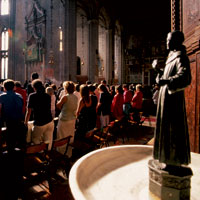
Intimacy with Scripture is essential for the church, say those who have made Bible reading an individual and corporate discipline. Richard Hays, the George Washington Ivey Professor of New Testament at Duke Divinity School, believesthat Christians are “formed” by a deep encounter with Scripture, and also by studying the church’s long history of scriptural interpretation. “We learn to read Scripture well by sitting at the feet of Christians, past and present, who are wise readers of the text, and by meditating on God’s word day and night,” explains Hays, who was the keynote speaker at SPU’s President’s Symposium in November 2006. “As Psalm 1 declares, those who do so will be like trees planted by streams of water, whereas those who do not immerse themselves in Scripture will be like chaff blown about by the wind.”
New Testament scholar N.T. Wright, the bishop of Durham, England –– also a former President’s Symposium speaker –– has been reading the Bible daily since he was 12. “Even the bits I know continually surprise me with new angles,” he says.
Each person will find their own way of reading Scripture, notes Wright: “Never forget that the four gospels are the center of it all, and that the Jesus we meet there is the human face of the living God. But remember that the Jesus we meet there was the Jesus who knew the Psalms so well that even in the agony of torture and death he couldn’t help quoting one of them.”
 Wright also notes, “Billy Graham once said that he read five Psalms a day ‘because they help me to get along with God’ and a chapter of Proverbs every day ‘because it helps me to get along with man’. There is great wisdom there, however we apply it individually.” Wright also notes, “Billy Graham once said that he read five Psalms a day ‘because they help me to get along with God’ and a chapter of Proverbs every day ‘because it helps me to get along with man’. There is great wisdom there, however we apply it individually.”
In the midst of daunting daily challenges, Seattle Pacific alumna Kim Hodges Gerdes ’94 says she can’t help but turn to Scripture. The program director of the Kindering Center in Bellevue, Washington, Gerdes helps provide services for more than 2,000 infants and children with special needs. It is a way in which she helps others cope with challenges much like her own. She and her husband, Jeff Gerdes ’96, are raising their son, Toby, who has a developmental disability.
“I don’t know how to deal with life’s pressures except by renewing my mind with Scripture, by filling my mind with what is holy and true,” says Gerdes. She says she finds that knowing about Christ’s love for her is not enough; she needs to be in a process of knowing him better. “If we’re really seeking him, then we will naturally do what he’s calling us to do. We’re more likely to be serving him and doing the work of his kingdom if we’re spending time in God’s word.”
The senior pastor of Seattle’s University Presbyterian Church, Earl Palmer, also knows the rewards of regular Bible reading. He says it was during his undergraduate years at the University of California-Berkeley that “the Bible first became a book I really wanted to read.
“It was my discovery of the Jesus Christ of the Bible that made the difference for me, because Jesus Christ as Redeemer and Lord integrated the parts [of my life] into a new whole,” recalls Palmer. “Once we make this discovery, we are then invited to grow with and into the great texts of the holy Bible so that they become an alive part of our own daily intellectual and moral life as well as our friendly companion.”
The Bible as Key to Engagement
Those who are planted in Scripture, says business leader Max De Pree, become effective leaders –– in every aspect of their lives. Author of the best-selling book Leadership Jazz, De Pree points to the key elements of leadership: trust, which is based on truthfulness; forgiveness, which helps others reach their potential; good community relationships, which is a more rewarding goal than selfish gain; and personal restraint, which helps people resist destructive trends.
“Biblical literacy is a great help and guide in understanding any of these elements,” concludes De Pree.
N.T. Wright would agree: “The more you read [Scripture], the more it enables you to have a many-sided engagement with the world for the gospel. If you rely on what you learned at Sunday school, don’t be surprised if your ‘engagement’ gets just a little thin.”
Hays reminds Christians that attentive Bible readers will encounter “the imperative that the people of God should care for the poor, renounce violence, and seek racial and ethnic reconciliation within the community of faith.”
Few Christian leaders have fulfilled that imperative more vividly than John Perkins, SPU’s partner in the Perkins Center for Reconciliation, Leadership Training, and Community Development. Now 76 years old, Perkins continues a lifelong commitment to minister to the needs of the poor and champion the cause of biblical reconciliation between all people.
For Perkins, knowledge of the Bible has brought with it both joy and suffering. His ministry of proclaiming Jesus to the poor began one Sunday morning, when a preacher shared Romans 6:23: “For the wages of sin is death; but the free gift of God is eternal life through Jesus Christ our Lord.” Inspired, Perkins went out to share the “free gift of God” with the people of Mendenhall, Mississippi.
When Perkins began teaching young black men to “dig into the Bible and find out what it says,” he and his supporters became the victims of hate-fueled violence. As he recounts in Let Justice Roll Down (Regal Books, reprinted 2006), he was tortured and almost killed by white law enforcement officers. In 1971, as he lay in a hospital bed recovering from his ordeals, he thought back on the evil he had witnessed and suffered due to racism. Hate would have been an easy response.
“An image formed in my mind,” he wrote. “The image of the cross — Christ on the cross.” Perkins recalled the biblical account of Jesus’ arrest, beatings, and crucifixion. Yet, Perkins realized, the Bible says that Jesus loved and forgave his enemies even when they killed him.
Perkins rose from that hospital bed and, empowered by Scripture, blazed new trails in promoting biblical reconciliation and community development. “The word of God is the spiritual nurture that one needs in order to have a full and meaningful life in society,” says Perkins today. “It gives us spiritual strength.”
The Greatest Story Ever Lived
A view of Scripture as the big story that “guides us to human flourishing” has prompted Seattle Pacific University President Eaton to lead a new initiative addressing the epidemic of biblical illiteracy. “Seattle Pacific is a university committed to biblical and theological education, a university that places the Bible at the heart of our learning enterprise,” he says. “Can we model a way in which young people will discover the big story of the Bible and their place in that story? I believe we can.”
According to David Neff, editor and vice president of Christianity Today, it is through story that God ultimately reveals himself in Scripture.
Neff says, “If the Bible and biblical faith were not a dramatic rescue story but instead a set of ideas, then we could do with a simple handbook of beliefs, and we wouldn’t need the Bible … But since the biblical God is someone who acts in human history, we need to know the story of salvation up to this point so we can recognize God’s saving interruptions in our own lives.”
The narrative of the Bible, and the way it characterizes all of history as a story — that might be the key to inspiring a resurgence in Biblical literacy, both in the church and in the nation. American culture is saturated with advertising, and many put up their guard to escape any kind of “message.” But the power of story appeals to everyone.
In Eat This Book, SPU alumnus Eugene Peterson ‘54 laments the way that contemporary Christians tend to “cherry-pick” verses from Scripture to support their own agendas. He sees the “evisceration” of the Bible’s narrative as proof that the church has conformed to a culture of marketing ploys. “The church thinks now it has to provide some kind of an alternative that’s just as exciting, just as novel, and to try to attract people like marketers attract [consumers with] new products. That cheapens the gospel.”
That’s why he crafted the internationally celebrated Bible translation in contemporary language called The Message. “I was trying to recover the story,” he says. “You need to read the Bible like you read a novel. You can’t understand any one part of it without reading the whole Bible. Nobody picks a paragraph out of Ulysses and says, ‘What does this mean?’”
If Americans were to re-discover the story of Scripture, they might find themselves caught up in its drama –– and its relevance. David Plotz, the atheist deputy editor of Slate, recently decided to read through the Bible for the first time, and he’s been chronicling his thoughts in Slate’s “Blogging the Bible” feature ever since. “I didn’t think biblical literacy mattered until I finally read the Bible,” he says. “Reading the Bible is like opening the blinds on your culture. You suddenly understand where our stories, language, clichés, aphorisms, and jokes come from. Biblical literacy matters for another reason, too: It narrows the divide between religious and unreligious Americans. Civil society depends on all of us attempting to understand the beliefs and ideas of our fellow citizens, even those citizens you think are wrong.”
For Christians, the rewards are even greater. Those who draw strength from Scripture daily, and who believe that its claims are true, know that biblical literacy enriches our lives, strengthens our cultural engagement, and gives us a sense of place and purpose in the greatest story ever told.
—by Jeffrey Overstreet
— Photos by getty images and Oleg Prikhodko/Stockphoto.com
[Editor's note: This is the expanded version of this article.]
Back to the top
Back to Features Home
|
| |
|
|
|

|
|
from the president
Embracing the Christian Story
SPU President Philip Eaton asks what would happen if the Bible were at the center of the learning enterprise.
campus
Destination: Asia
SPU President Philip Eaton joined a historic delegation of U.S. university presidents that visited Asia.
alumni
Coffee as Change Agent?
Pura Vida employees, including several SPU alumni, engage the culture using a social-venture business model.
books, film, & music
Dark Alphabet
Jennifer Maier, poet and SPU associate professor of English, receives a literary award for her first book.
athletics
National Tournament Returns
For the first time in 10 years, SPU hosts the USA Gymnastics Women's Collegiate Championship.
my response
Undone by the Word
Response writer Kathy Henning shares her journey to know the Bible better.
Response art
Pink Emperors
Class of 1973 alumna Jill Ingram introduces Response readers to “Pink Emperors.”
|
|
|
|